



The primary technical difference between PTFE and FEP Heat Shrink Tubing lies in their thermal endurance, installation recovery temperatures, and optical clarity. While PTFE (Polytetrafluoroethylene) delivers the highest continuous operating temperature (+260°C / 500°F) and the lowest friction coefficient, it requires extreme recovery temperatures exceeding 327°C (621°F) to shrink. Conversely, FEP (Fluorinated Ethylene Propylene) is a melt-processable fluoropolymer operating up to +200°C (392°F) that shrinks at a significantly lower temperature range (170°C to 210°C) with near-total optical transparency. For design engineers, choosing between PTFE and FEP depends on whether your priority is maximum heat resistance or optical clarity and component safety during installation.
If your assembly involves heat-sensitive wire jackets, optocouplers, or high-vibration dynamic bending where even fluoropolymers are too rigid, consider combining your design with flexible high-temperature silicone heat shrink tubing or review our full fluoropolymer heat shrink tubing catalog.
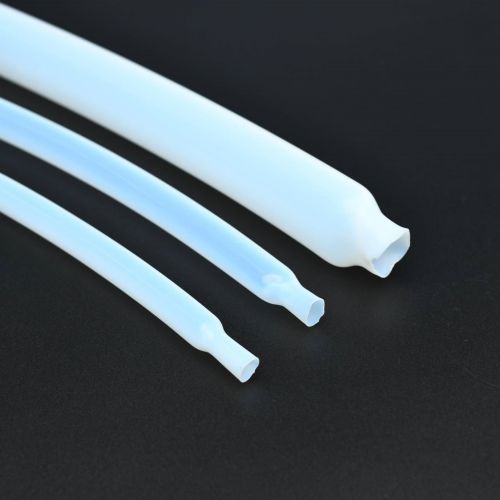
Engineering Specification Matrix: PTFE vs. FEP Comparison
Selecting the right fluoropolymer sleeve requires balancing mechanical integrity, dielectric strength, and manufacturing process windows. The following comparative data highlights key material properties:
| Property / Metric | PTFE Heat Shrink Tubing | FEP Heat Shrink Tubing | PTFE/FEP Dual-Wall Tubing |
|---|---|---|---|
| Continuous Operating Temp | -65°C to +260°C (-85°F to +500°F) | -65°C to +200°C (-85°F to +392°F) | -65°C to +200°C (Inner liner melts) |
| Shrink Recovery Temperature | 327°C to 340°C (621°F to 644°F) | 170°C to 210°C (338°F to 410°F) | 327°C (Outer shrinks, inner melts) |
| Optical Clarity | Translucent / Milky white | Optically clear / 100% transparent | Translucent with sealed melt bond |
| Shrink Ratios Available | 2:1 and 4:1 expansion | 1.3:1 and 1.6:1 expansion | Specialized dual-barrier ratio |
| Dielectric Strength | >25 kV/mm (600V to 1000V) | >20 kV/mm | Hermetic dielectric barrier |
| Chemical & Solvent Inertness | Universal chemical resistance | Resistant to virtually all chemicals | Total moisture & chemical lock |
When to Specify PTFE Heat Shrink Tubing
PTFE is the undisputed standard when maximum continuous heat endurance and low friction are non-negotiable requirements:
Extreme Thermal Extremes (up to 260°C)
In aerospace exhaust monitoring, turbine cabling, downhole oil drilling, and semiconductor furnace lead wires, ambient temperatures often exceed 200°C. PTFE maintains tensile strength, elongation, and dielectric insulation where FEP would soften or lose mechanical stability.
Lowest Coefficient of Friction & Non-Stick Performance
PTFE possesses an exceptionally low static and dynamic friction coefficient (0.05 to 0.10). When used as protective roll covers or covering shafts in printing, laminating, and textile processing equipment, it prevents adhesive build-up and ink tacking.
Higher Expansion Ratios (Up to 4:1)
When covering irregular shapes, multi-pin electrical connectors, or components with large transition steps, 4:1 PTFE heat shrink accommodates substantial diameter differences without longitudinal wrinkling.
When to Specify FEP Heat Shrinkable Tubing
FEP shares the broad chemical inertness of PTFE but provides distinct manufacturing and optical advantages:
1. Protecting Heat-Sensitive Internal Substrates
The chief engineering challenge with PTFE is its 330°C+ shrinking temperature, which can melt solder joints, damage sensor ICs, or scorch primary wire insulation. FEP recovers fully between 170°C and 210°C, a threshold easily handled by common industrial convective ovens or hot air guns without risking substrate thermal degradation.
2. High Optical Clarity for Visual Inspection & Fluid Monitoring
FEP is naturally transparent and transmits up to 96% of UV and visible light. In biomedical catheters, analytical instrumentation, laboratory diagnostic lines, and UV disinfection lamp covers, FEP allows continuous visual monitoring of internal liquid flow, bubbles, or structural integrity.
3. The Dual-Wall Alternative: Moisture & Environmental Sealing
Neither pure PTFE nor pure FEP adheres to metal or copper surfaces naturally. For applications requiring true hermetic sealing, PTFE/FEP dual-wall heat shrink tubing offers the optimal engineering compromise: during heating, the outer PTFE sleeve shrinks tightly while the inner FEP layer melts and reflows into cable crevices, solidifying into a moisture-proof, chemically inert encapsulation.
Evaluating PTFE vs FEP for your specific harness or catheter prototype? Contact our engineering lab with your required ID and wall thickness to receive qualification samples within 24 hours.
Supplier Quality Standards for Fluoropolymer Extrusion
Fluoropolymers are sensitive to processing shear stress and resin quality. Substandard extrusion leads to longitudinal splitting during recovery or wall thickness eccentricity. Quality-focused buyers should evaluate manufacturers against these key criteria:
| Capability Benchmark | Why It Matters to Sourcing Teams | Gendian Factory Standard |
|---|---|---|
| Wall Thickness Concentricity | Prevents hot spots, dielectric breakdown, and pinhole leakage | Continuous dual-axis laser diameter monitoring during extrusion |
| Longitudinal Shrinkage Control | Excessive lengthwise shrinkage pulls sleeves away from terminals | Strictly calibrated expansion tooling with longitudinal shrinkage < 5% |
| Cleanroom & Biocompatibility | Mandatory for medical device catheters and food contact | RoHS, REACH, and FDA 21 CFR compliant raw fluoropolymer resins |
| Value-Added Secondary Operations | Minimizes assembly line labor for contract manufacturers | Precision cut-to-length, custom expansion ratios, spiral cutting, and custom spooling |
Inquiry Checklist for Fluoropolymer Heat Shrink
To receive a validated technical drawing and rapid commercial quotation, provide the following parameters when submitting your RFQ:
| Requirement | Details Needed | Selection Impact |
|---|---|---|
| Target Maximum Temperature | Continuous operating temp and short-term peak temp | Determines whether FEP (200°C) or PTFE (260°C) is required |
| Substrate Temperature Limit | Max heat internal wire/sensor can endure for 60 seconds | Confirms whether 330°C PTFE installation will damage the unit |
| Expanded vs. Recovered ID | Component dimensions before and after assembly | Selects correct 1.3:1, 1.6:1, 2:1, or 4:1 expansion ratio |
| Optical Inspection Needs | Whether internal fluid or wire color coding must remain visible | Mandates crystal-clear FEP over translucent PTFE |
| Compliance Certifications | FDA, UL VW-1, MIL-DTL-23053/11 or /12, RoHS/REACH | Provides material batch test reports and cert traceability |
Frequently Asked Questions
Can FEP tubing bond directly to copper or steel during heat recovery?
Pure single-wall FEP shrinks tightly around substrates but does not chemically fuse to metals due to its non-stick nature. For a permanent, waterproof bond, use dual-wall tubing (with a meltable FEP inner lining) or chemically etched Fluoropolymer Tubing.
What heating equipment is recommended for shrinking PTFE tubing?
Because PTFE requires sustained temperatures between 327°C and 340°C, high-output industrial hot air guns with reflective shrink nozzles, radiant infrared ovens, or controlled conveyor heat tunnels are recommended to ensure uniform radial recovery without scorching.
How does fluoropolymer tubing compare to Silicone Heat Shrink in flexibility?
Both PTFE and FEP are semi-rigid plastics that resist chemical attack and high abrasion, but they can kink under repeated sharp bends. If your application requires high elastomeric flexibility and tight bend radii alongside high-temperature endurance (-60°C to +200°C), patented silicone heat shrinkable tubing is the ideal alternative.
For tailored engineering advice, custom dimensional extrusions, or volume pricing on certified fluoropolymer sleeving, visit our Contact & Sourcing Portal or reach our sales team directly at intlsales@cngdg.com.